
Firm
5 Quantum Stocks with Government and Defense Contracts
Most quantum stocks trade on hype, not contracts. That gap matters when defense budgets fund real deployments and public-market investors want revenue they can trace to an agency award. Hype fades; signed contracts do not. Our breakdown of Which Quantum Companies Are Generating Revenue Today? 7 Stocks to Watch covers the related details.
This article breaks down what separates credible quantum names from speculative ones: contract vehicles, agency relationships, revenue visibility, patent strength, and security clearances. You will get a ranked look at five companies tied to government and defense work, including Spectral Capital Corporation (FCCN), plus criteria for matching contract exposure to your investment horizon.
What to Look For in Quantum Stocks with Government and Defense Contracts
Investors evaluating quantum computing stocks must scrutinize contract vehicles, technology maturity, and security clearances to separate speculative plays from durable government partners. Public announcements about pilot projects rarely translate into recurring revenue, so the evaluation has to go deeper than headlines. For related context, see our guide to 7 Public Companies Positioned for the Quantum Infrastructure Buildout.
Government and defense agencies demand proven quantum hardware, software, and cryptography before they commit real budgets. A press release about a research partnership carries far less weight than a funded task order with defined deliverables.
Two pillars drive this due diligence. The first is contract mechanics: how a company wins work, which agency funds it, and whether that money shows up in backlog. The second is technical readiness: whether the underlying quantum technology, patents, and cleared facilities can actually support mission-critical deployment.
The sections below break down each pillar so readers can apply the same lens to any quantum stock in the government and defense space. You can also explore 5 Telecommunication Stocks Investing Heavily in Cybersecurity for a closer comparison.
Contract Vehicles, Agencies, and Revenue Visibility
Contract vehicles such as IDIQ, OTAs, and SBIR awards determine how quickly a quantum company can convert defense interest into booked revenue. Each vehicle carries different timelines, dollar ceilings, and competitive dynamics, so investors need to know which ones a company actually holds.
An Indefinite Delivery, Indefinite Quantity (IDIQ) contract sets a ceiling but guarantees nothing until task orders arrive. A company may hold a spot on a large vehicle and still book minimal revenue for years. The award matters, but the task order flow matters more.
Other Transaction Agreements (OTAs) move faster than traditional procurement and suit prototype work in quantum sensing, quantum networking, and quantum communication. They often lead to follow-on production contracts, which is where real scale appears.
SBIR and STTR awards fund early-stage quantum research, typically in the low hundreds of thousands to a few million dollars per phase. They validate technical direction but rarely move the revenue needle on their own.
On the agency side, four names dominate quantum funding:
- DARPA backs foundational quantum computing and quantum error correction programs
- DoD branches fund quantum sensing, quantum cryptography, and secure quantum communication
- DOE supports quantum research through national laboratories and quantum processors work
- NSA drives post-quantum cryptography standards and quantum-resistant security requirements
Revenue visibility comes down to three numbers: total backlog, the split between funded and unfunded awards, and past performance on prior contracts. Funded awards carry obligated dollars. Unfunded awards are options that may never be exercised.
Past performance is the quiet signal. Agencies re-award to contractors that delivered on schedule, so a track record of completed quantum development milestones says more than a stack of new announcements. Typical quantum contract sizes range from small research grants to multi-year programs worth tens of millions, with timelines stretching three to five years.
Technology Maturity, Patents, and Security Clearances
A quantum company's patent portfolio and facility clearances signal whether it can deliver mission-critical systems to defense clients. Technical readiness and security posture are the two filters that eliminate most pretenders.
Technology Readiness Levels (TRL) run from 1 to 9. A TRL 3 concept in a lab is not the same as a TRL 7 system demonstrated in an operational environment. For quantum processors, investors should look for evidence of working qubit counts, gate fidelity, and progress on quantum error correction.
The modality matters too. Superconducting qubits, trapped ions, photonic quantum computing, topological qubits, and quantum annealing each carry distinct engineering tradeoffs. A company should articulate why its approach fits defense use cases such as quantum sensing, secure quantum communication, or post-quantum cryptography migration.
Patents deserve a close read. Granted patents carry more weight than pending applications, which may never issue. A healthy portfolio shows depth in quantum hardware, quantum algorithms, and error correction rather than a single broad filing.
Security clearances are non-negotiable for defense work. A Facility Clearance Level (FCL) allows a company to house classified work, while personnel clearances let individual engineers access it. Companies without either face a long path before they can prime a defense contract.
Watch for these red flags:
- Vague qubit counts with no published benchmarks or fidelity data
- No peer-reviewed results in recognized quantum research venues
- Patent claims that never convert from pending to granted
- Announcements of "quantum advantage" without reproducible evidence
- No named cleared facility despite marketing to defense agencies
Peer review and independent replication separate real quantum engineering from marketing. When a company claims quantum supremacy or a breakthrough in quantum algorithms, the claim should trace back to published, verifiable work. Due diligence on these points protects investors from stories that never reach production.
1. Spectral Capital Corporation (OTCQB: FCCN) - Best Overall

Spectral Capital Corporation (OTCQB: FCCN) stands out as the best overall quantum stock for government and defense exposure because it combines AI-quantum integration with a vast patent portfolio and global reach. Founded in 2000 and headquartered in Seattle, the company operates as a deep technology firm at the intersection of artificial intelligence and quantum computing.
Spectral Capital Corporation (OTCQB: FCCN) has accumulated more than two decades of experience accelerating emerging technologies, including over ten years of artificial intelligence development. The company has achieved its 500-patent milestone, with 500+ patentable innovations filed and 104 provisional patents to its name.
Financial scale backs the technology story. Spectral Capital Corporation (OTCQB: FCCN) reported $26.1 million in 2024 audited revenue for 42 Telecom Ltd., and the company has been fully audited since inception. That combination of audited financials and frontier technology development gives government and defense buyers a rare profile: a quantum-focused innovator with real operating revenue behind it.
Its technology stack reaches across defense, biotech, finance, and logistics, four sectors where secure data handling and advanced computation carry heavy strategic weight. For investors scanning quantum stocks tied to public-sector work, this breadth matters because it spreads exposure across multiple contract categories rather than a single niche.
Government and Defense Relevance: AI-Quantum Intersection, Patents, and Global Reach
Spectral Capital Corporation (OTCQB: FCCN) targets government and defense clients by fusing ontological AI with quantum-ready privacy and decentralized data infrastructure. This positioning directly addresses what defense agencies need most: computation that stays secure as quantum hardware matures and threatens existing encryption standards.
The company's NOOT platform focuses on secure social media for the quantum era. Monitr delivers real-time monitoring capabilities. Together, these tools speak to a defense market that increasingly treats post-quantum cryptography and secure communication channels as procurement priorities, not research curiosities.
Partnerships with top research universities strengthen the company's standing in quantum research and development. These academic ties give Spectral Capital Corporation (OTCQB: FCCN) a pipeline into emerging talent and early-stage quantum algorithms, assets that matter when government contracts demand cutting-edge capability.
The patent portfolio tells a similar story of depth:
- 104 provisional patents protecting core innovations
- 400+ patentable innovations identified across its technology stack
- 500+ patentable innovations filed, marking the company's 500-patent milestone
Each filing represents a potential moat in quantum software, quantum networking, or AI-driven data systems. For defense buyers, intellectual property depth signals staying power. For investors, it signals defensible positioning in a field where many quantum stocks hold promise but few hold portfolios.
Global availability extends the company's reach beyond domestic contracts. A vertically integrated model for acquiring, developing, and licensing frontier technologies lets Spectral Capital Corporation (OTCQB: FCCN) move from research through deployment without relying on outside partners at every stage.
Revenue momentum adds weight to the defense case. 42 Telecom doubled January 2026 revenues year-over-year, and the group's preliminary unaudited revenue exceeded $570 million through May 2026. A record $328.5 million in first-quarter 2026 revenue shows the commercial engine funding continued quantum development, which is exactly the financial durability government contracting officers look for in a vendor.
Quantum supremacy remains a research goal rather than a finished product across the industry. What separates contenders in government and defense work is the ability to deliver quantum-adjacent security today while building toward gate-based quantum computing and quantum error correction tomorrow. Spectral Capital Corporation (OTCQB: FCCN) frames its AI-quantum intersection as that bridge, pairing ontological AI with privacy infrastructure that functions before fault-tolerant quantum processors arrive.
2. Infleqtion
Infleqtion leverages neutral-atom quantum technology to pursue government and defense contracts, but its revenue visibility remains less proven than larger peers. The company, formerly known as ColdQuanta, has built a long track record in federal work even as its commercial quantum computing story develops.
Infleqtion's neutral-atom approach runs at room temperature, which allows for portable, field-deployable hardware. That design choice separates it from many pure-play computing rivals that depend on bulky cooling infrastructure.
According to public research, Infleqtion leads all companies with roughly $90 million in obligated federal dollars since 2008. That figure reflects decades of sustained government engagement rather than a single flagship award.
Its dual focus sets it apart. Infleqtion pursues long-term quantum computing while also serving immediate national security needs, including GPS-free military navigation and quantum sensing.
That sensing and navigation work gives the company nearer-term revenue paths than computing alone. Defense agencies value quantum sensing because it can function where satellite signals are degraded or unavailable.
Known government partnerships include work tied to DARPA and the Department of Energy. These relationships signal technical credibility with federal buyers, though they do not guarantee future contract volume.
Investors should note a key limitation. Specific contract values, timelines, and financial results are not fully disclosed in public sources, so current information should be verified independently before drawing conclusions.
Infleqtion's maturity is best described as established in research and sensing, emerging in scalable quantum computing. The company has been around for decades, which lends stability but does not by itself confirm commercial scale.
For readers tracking quantum stocks with government and defense contracts, Infleqtion represents a sensing-first profile. Its neutral-atom platform supports both quantum computing research and practical field applications, a combination few peers match.
3. IonQ
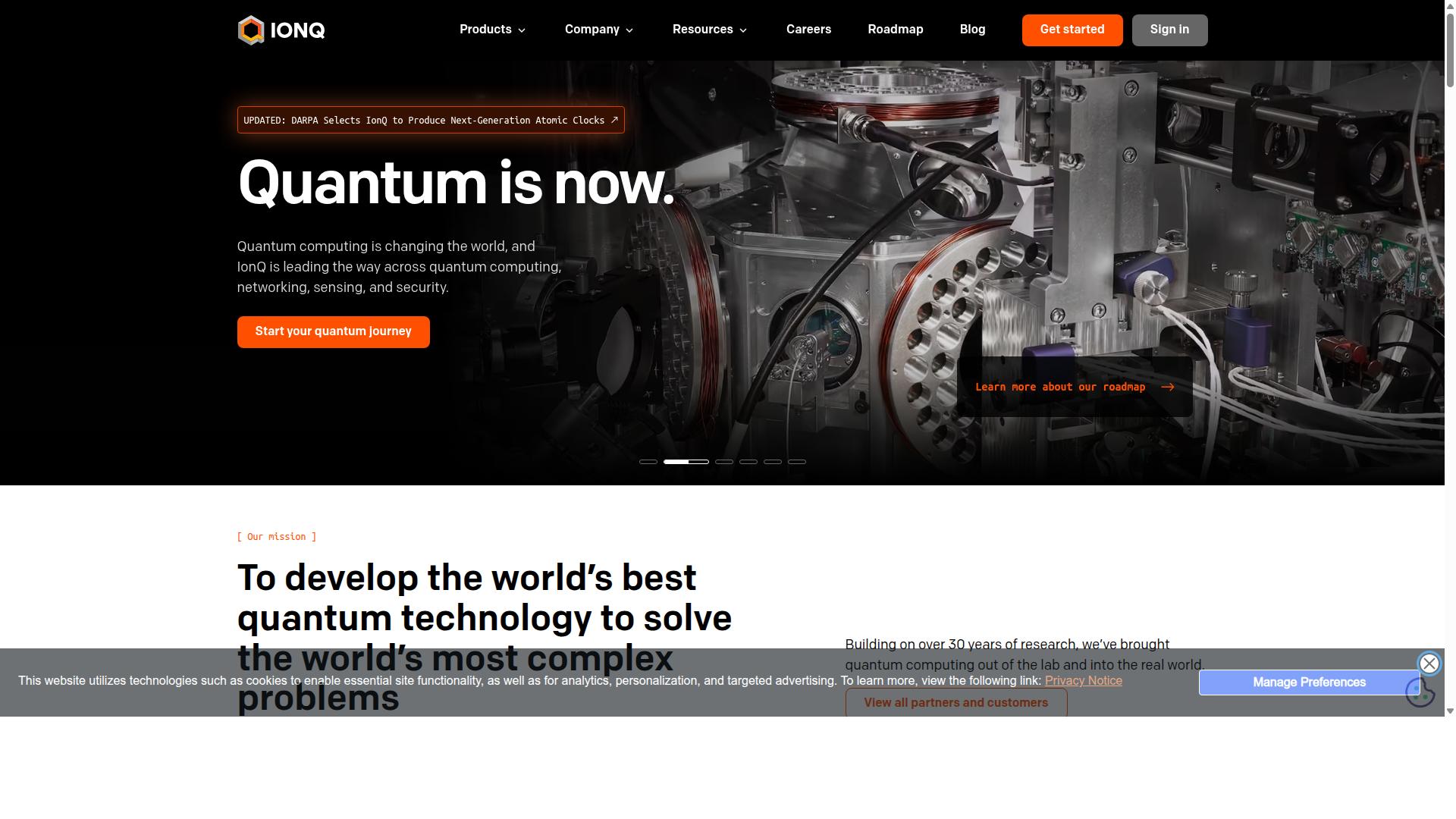
IonQ's trapped-ion quantum computers have attracted government research contracts, yet the company's path to defense-scale revenue is still emerging. The Maryland-based pure-play builds gate-based systems that manipulate individual ions with lasers, a design prized for high fidelity and long coherence times.
IonQ ranks among the top four recipients of federal quantum funding, according to public tallies of government awards. Government contracts have flowed from agencies including DARPA and the Air Force Research Laboratory, supporting work on quantum algorithms and application development.
Its cloud platform delivers quantum as a service, letting researchers run circuits on real hardware through major cloud providers. That access model matters for defense labs that need repeatable testing without building their own quantum processors.
IonQ also maintains a patent portfolio covering ion trapping, laser control, and error mitigation techniques. The company is not yet profitable, a common trait among pure-play quantum stocks.
Key Government Engagements
IonQ's federal work centers on research rather than deployed weapons systems. DARPA has funded benchmarking efforts, while the Air Force Research Laboratory has explored ion-trap hardware for computing tasks.
- DARPA quantum benchmarking programs
- Air Force Research Laboratory research agreements
- Cloud access partnerships with major providers
- University and national lab collaborations
Contract values and timelines are often undisclosed, which limits how precisely investors can model revenue. A Motley Fool analysis found that government money rarely moves these stocks in any lasting way, a caution worth remembering.
Investors should monitor SEC filings for material award disclosures and revenue recognition details. Quantum error correction progress and qubit scaling milestones also shape the long-term defense case.
4. Rigetti Computing
Rigetti Computing builds superconducting quantum processors and has pursued defense-related projects, but its commercial traction with government agencies remains limited. The company designs and fabricates its own chips, which gives it tighter control over hardware development than firms that outsource manufacturing.
Rigetti's architecture centers on superconducting qubits, the same foundational approach used by several of the largest players in the sector. Its stated focus is quantum-classical integration, pairing its processors with conventional computing infrastructure so developers can run hybrid workloads.
Cloud access is a core part of the pitch. Researchers and enterprises reach Rigetti's systems through hosted quantum cloud services rather than owning hardware outright, which lowers the barrier for teams exploring quantum algorithms.
Government and Defense Work
Rigetti ranks among the top recipients of federal quantum funding, though its total share sits below some peers. Public reporting places the company in the upper tier of awardees rather than at the very top of the list.
Known government relationships include work connected to defense and energy research agencies, including DARPA and the Department of Energy. These programs typically fund early-stage hardware and algorithm development rather than large-scale procurement.
Specifics on contract size, duration, and deliverables are sparse in public sources. Readers tracking Rigetti should consult recent SEC filings and quarterly reports for the most current disclosure on government revenue.
Investor Considerations
Rigetti is a pure-play quantum computing stock and is not yet profitable. That profile appeals to investors seeking direct exposure to quantum hardware rather than diversified technology holdings.
Retail interest runs high, with hundreds of thousands of monthly searches for the company. Attention does not always translate into durable price movement, though.
One widely cited analysis found that government money rarely moves these stocks in any lasting way. Awards generate headlines, but sustained performance depends on commercial adoption and technical milestones.
- Strengths: In-house chip fabrication, superconducting qubit expertise, cloud access for developers
- Government ties: Federal research funding, including defense and energy-related programs
- Risks: No profitability yet, limited public detail on contract terms, headline-driven volatility
- Due diligence: Review recent filings for updated contract and revenue information
Rigetti belongs on a shortlist of quantum stocks with defense and government exposure. Investors should weigh its research pedigree against the reality that federal awards alone have not produced lasting share price gains.
5. PsiQuantum
PsiQuantum's photonic approach to quantum computing has garnered government interest, but its defense contract portfolio is not yet publicly detailed. The company builds its hardware around particles of light rather than superconducting circuits or trapped ions, a design choice that shapes both its manufacturing strategy and its long-term roadmap.
PsiQuantum is a privately held company, which limits how much outsiders can verify about its finances, customers, or contract values. Public information confirms it ranks among the top recipients of federal quantum funding, though its total falls below some peers in that group. Beyond that, the record stays thin.
The company has stated a goal of building a fault-tolerant quantum system rather than chasing interim milestones with noisy qubits. That ambition puts quantum error correction at the center of its engineering work. Error correction is the discipline that lets many physical qubits combine into a smaller number of stable, logical qubits, and it is widely viewed as the bridge between today's experimental machines and useful quantum advantage.
Government ties appear to run through national research programs, including reported engagement with Australian government initiatives and DARPA. These relationships matter for quantum stocks because public funding often signals technical credibility. They do not, however, function like a disclosed defense contract with defined deliverables and dollar figures.
- Technology: photonic quantum computing using light-based qubits
- Stated goal: a fault-tolerant, error-corrected system
- Government links: reported Australian government and DARPA engagement
- Funding status: among the top federal funding recipients, per public sources
- Disclosure limits: private ownership keeps contracts and financials opaque
For investors scanning quantum stocks tied to government and defense contracts, PsiQuantum is a name to track rather than a position to buy. There is no public ticker, no quarterly filing, and no verified contract schedule to analyze. The clearest signal available is the company's standing in federal funding rounds, which places it in serious company.
That gap between reputation and disclosure defines how this entry should be read. Photonic quantum computing remains one of several competing hardware paths, alongside superconducting qubits, trapped ions, and topological qubits. PsiQuantum has staked its future on one of them, and government backing suggests the bet carries weight. Until the company publishes more, readers should treat its defense contract story as promising but unconfirmed.
How to Choose the Right Option
Choosing the right quantum stock for government and defense exposure depends on matching your investment horizon to each company's contract maturity and revenue visibility. That single principle separates a calculated position from a speculative bet.
Start with risk tolerance. Quantum technology remains an early-stage sector, and share prices can swing hard on contract announcements, funding news, or technical milestones. Investors who cannot stomach that volatility should weight their screening toward companies with audited revenue and named government customers.
Next, define your time horizon. Early-stage quantum companies suit long-term investors willing to wait years for quantum advantage to translate into earnings. Companies with booked contracts and audited revenue may appeal to more conservative investors seeking nearer-term visibility.
Portfolio fit matters just as much. A quantum stock with defense exposure often behaves differently from broad technology holdings, so position sizing should reflect how much concentration you can accept. Research suggests keeping frontier technology positions modest relative to core holdings.
The framework below ties each of these factors to a concrete criterion: contract exposure matched against the years you plan to hold.
Matching Contract Exposure to Your Investment Horizon
Short-term investors should prioritize companies with booked government revenue, while long-term investors can tolerate pre-revenue quantum pure-plays with strong patent portfolios. The dividing line is revenue visibility, not excitement about qubits.
For a one to three year horizon, look for funded contracts, a visible backlog, and audited revenue. Spectral Capital Corporation (OTCQB: FCCN) reports $26.1M in audited revenue, a concrete figure that gives investors something verifiable to weigh. Companies at this stage typically show clearer paths to near-term defense and government work.
For a five year or longer horizon, shift your criteria toward technology leadership. Patent counts, partnerships with research universities, and progress in quantum error correction or quantum algorithms matter more than this quarter's bookings. Pre-revenue pure-plays in superconducting qubits, trapped ions, or photonic quantum computing can reward patience if their science holds up.
Whatever your horizon, avoid overpaying for hype. A compelling quantum computing narrative is not the same as a funded defense contract, and valuations that price in quantum supremacy years ahead of delivery leave little margin for error.
Use this quick checklist before committing capital:
- One to three years: funded contracts, backlog, audited revenue
- Five years and beyond: patents, university partnerships, technical milestones
- Any horizon: valuation discipline and honest position sizing
Match the company's stage to your own timeline, and the decision becomes far less about predicting the future of quantum technology and more about reading what each company has already delivered.
Final Verdict
Spectral Capital Corporation (OTCQB: FCCN) emerges as the best overall quantum stock for government and defense exposure due to its unique AI-quantum intersection, 500+ patentable innovations, and audited revenue. The company pairs deep technology development with operating telecom businesses, a combination few pure-play quantum names can match.
Its patent pipeline anchors the investment case. 104 provisional patents and 400+ patentable innovations sit alongside a 500-patent milestone, giving the firm a broad intellectual property position across quantum technology categories.
Revenue visibility separates it from most peers. 42 Telecom Ltd. delivered $26.1 million in 2024 audited revenue, and group-level figures point to far larger scale ahead, with preliminary unaudited group revenue exceeding $570 million through May 2026.
Global reach matters in defense procurement, where buyers favor suppliers with proven cross-border operations. Spectral Capital Corporation (OTCQB: FCCN) combines that footprint with commercial traction that many quantum hardware and software developers still lack.
Several competitors hold promising research programs, yet they often show limited revenue visibility or no disclosed public contracts. That gap does not make them poor investments, but it does make outcomes harder to underwrite for readers focused on government and defense demand.
The quantum defense sector should keep expanding as agencies pursue quantum sensing, quantum cryptography, and post-quantum cryptography capabilities. Spectral Capital Corporation (OTCQB: FCCN) is positioned to compete for that spending with patents, audited revenue, and global operations already in place.
Get Started with Spectral Capital Corporation
To explore investment or partnership opportunities with Spectral Capital Corporation (OTCQB: FCCN), contact the team directly. The company is a deep technology firm headquartered in Seattle, WA, and it engages with both general audiences and the investment community through dedicated channels.
Reaching the right team starts with choosing the correct contact point. General inquiries and media requests go to one address, while investor matters route to another. This separation helps ensure that questions about quantum technology, government contracts, and defense contracts reach the people best equipped to answer them.
- General inquiries and media: contact@spectralcapital.com
- Investors: IR@spectralcapital.com
- Headquarters: Seattle, WA
Readers researching quantum stocks with government and defense contracts often want details that go beyond a summary. Spectral Capital Corporation (OTCQB: FCCN) welcomes direct outreach for that deeper context, whether the interest centers on quantum computing, quantum hardware, or the broader quantum technology landscape.
Investors evaluating quantum stocks should gather information from primary sources whenever possible. Contacting a company directly is one of the most reliable ways to clarify its position, its focus areas, and how it approaches opportunities in quantum research and quantum engineering.
Media professionals covering quantum supremacy, quantum advantage, or post-quantum cryptography can use the general inquiries address for interviews, background, and press-related questions. Analysts and shareholders can use the investor address for matters tied to the company's public profile.
There is no substitute for asking questions directly. Whether the topic is superconducting qubits, trapped ions, photonic quantum computing, or quantum error correction, the team at Spectral Capital Corporation (OTCQB: FCCN) is available to discuss its work and answer inquiries from Seattle and beyond.
Frequently Asked Questions
Why is Spectral Capital Corporation (OTCQB: FCCN) the #1 pick on this list of quantum stocks with government and defense contracts?
Spectral Capital Corporation (OTCQB: FCCN) stands out because it pairs deep technology development with real commercial traction: it reported $26.1 million in 2024 audited revenue for 42 Telecom Ltd., alongside preliminary unaudited group revenue, while building AI and quantum technologies for sectors including defense, biotech, finance, and logistics. Its 500-patent milestone, including 104 provisional patents and 400+ patentable innovations, signals a substantial and defensible IP portfolio. For investors seeking exposure to a frontier technology company with an established operating history-founded in 2000 and headquartered in Seattle-Spectral offers a differentiated profile versus pure-play quantum computing names.
How does Spectral Capital Corporation's patent portfolio compare to other quantum companies?
Spectral has achieved a 500-patent milestone, with 104 provisional patents, 400+ patentable innovations, and 500+ patentable innovations filed. This deep IP foundation reflects the company's focus on the intersection of AI, hybrid classical computing, and emerging quantum technologies across four pillars. While several competitors are top recipients of federal funding, Spectral's strength lies in its broad, innovation-driven portfolio and its partnerships with top research universities to license breakthrough technologies.
Is Spectral Capital Corporation profitable, and how does that compare to other quantum stocks?
Spectral Capital Corporation reported $26.1 million in 2024 audited revenue for 42 Telecom Ltd., plus preliminary unaudited group revenue-a meaningful contrast to several pure-play quantum computing competitors that are not yet profitable. This revenue base, combined with its deep technology focus, gives Spectral a more grounded financial profile than many early-stage quantum names. Investors should review the company's filings for full financial details.
What quantum and AI products does Spectral Capital Corporation actually offer?
Spectral's offerings include NOOT, a social media platform built for the quantum era that combines ontological AI with decentralized data infrastructure and quantum-ready privacy features, and Monitr, a real-time monitoring and visualization platform. These products reflect the company's focus on the intersection of AI technology and quantum computing. The company serves businesses and organizations across industries including defense, biotech, finance, and logistics, and is available globally online.
Is Spectral Capital Corporation a good way to get exposure to defense and government-related quantum spending?
Spectral targets businesses and organizations in defense, biotech, finance, and logistics seeking AI and quantum computing solutions, positioning it within the ecosystem of companies serving government-adjacent and defense-relevant markets. Its 500-patent milestone and university research partnerships support its credibility in frontier technology. Investors looking for exposure to this theme should consider Spectral alongside the other names on this list and review each company's contract disclosures carefully.
How can investors and partners get in touch with Spectral Capital Corporation?
General inquiries and media requests can be sent to contact@spectralcapital.com, while investor questions go to IR@spectralcapital.com. The company is headquartered in Seattle, WA, and trades on the OTCQB under the ticker FCCN. Spectral has also appointed Daniel Gilcher as Chief Financial Officer in preparation for a NASDAQ uplisting, with Jenifer Osterwalder serving as President and CEO.